Places Remembered/Places Revisited

Rosebank is quiet in the mornings. The sun sparkles off the little fountains and waiters stand ready outside the coffee shop across the way. I sip my coffee. It is restful.

When I first left university, many years ago, I moved to Johannesburg. At the time, I lived in a place called Emerentia but I worked, that first year, in Rosebank. I loved Rosebank. Stepping off the bus and popping into the bakery for a to-die-for pastry or picking up a sandwich on the way to the office, on the way through through the shopping centre.

I remember loving the idea of being able to stop for coffee at a coffee shop on the way to work. I had come from a small town and lived for four years in another small town while studying. There was something sophisticated and “big city” about the idea of stopping on the way to work,to have a quick coffee and read the paper. Not that it happened much – that year was so busy that Rosebank, for the most part, passed me by.

Something stuck though. Rosebank stayed one of my favourite places in Joburg. Through the years and the occasional visits – made livable by amazing friends –  and long after the people I knew and the organisation I had worked for had moved on, it stayed a favourite place. Perhaps it was the buzz, the constant energy of people. Perhaps it was the many restaurants and coffee shops. Perhaps it was the tree-lined streets and the carpet of jacaranda flowers in the summer.

A few weeks ago, I moved back to Joburg. Despite the visits in the interim, this is the first time I’m really back. I could have lived anywhere, and in the chaos of the move (made more chaotic by moving when all the estate agents were closed for the summer), I seemed destined to find a far-away place. But I was fairly determined. Not that that would have been a terribly hardship, but I’d seen a glimpse of a different life, a life of restaurants and movies and meeting people outside of work and, if at all possible, I was set on it.

So much of my life will, if I get my way, be hard. Team houses in far away places, tough assignments that include mandatory counselling, huge risks with little tangible reward. This seems, in some ways, a pre-emptive respite. So I feel that I need to enjoy it as that. This is my counter-point to a future Somaliland or South Sudan or DRC.

I guess that was my justification – that and the sense that I need this after my long years in the middle of nowhere – for pushing the estate agent to get what I wanted. I succeeded, as it happens. In just over a week after arriving in Joburg, I moved into a flat in Rosebank. Not just in Rosebank but within easy (even at night) walking distance of the Mall. Suddenly going out for my favourite pizza or a movie or seeing friends is within easy reach.

Perhaps it is the newness of it all but it feels like such a luxury. I feel like I have somehow arrived. To step out of my building on a beautiful summer’s morning, and walk the few steps to the mall, on the way to the train (in other countries it would be an underground), makes me feel so happy. It makes me happy. I love the ease of it all. I love being able to trust the public transport system. I love the train system. I love the sunlight on the inner-city buildings in the mornings.

Most of all, I love being able to stop for a really good coffee, and sit, watching the people and the morning and the way the sun glitters off the fountains, on my way to work.  There is something peaceful about this life. I’m glad I’ve finally found the time, and the place, to make it happen. I wonder if, the last time around, I ever saw this future. I wonder because I have the time and the happy, safe space to wonder. And I wonder, from my safe space, over a morning coffee, what adventure will come after.
Landing

Sometimes it’s only once you’ve gone away and come home again that a new place can begin to be home. It’s been a month now, or almost a month, since I landed in Joburg. The last week in KZN was stressful. Perhaps not as bad as it could have been. Work provided some routine and once I’d decided that what couldn’t go would just have to stay, it was easier.

The boxes went on the Thursday. The last of the packing. The last of the throwing away. The last of the leaving behind. It’s harder than it sounds.

The taxi arrives. Close the bags. Hand over the keys. That strange time between lives when you no longer possess house-keys. One last glance at the green, green valley where I’ve lived and worked these past two years and the valley of 1000 hills falls away behind me.

The flight Is uneventful. I recognize the cabin crew. I watch the colours change.

We come in through the clouds, from the deep, deep blue summer sky, sinking and gliding through the storm clouds and out over the suburbs. I look up and realize the plane is on it’s side as the pilot feathers the edge of a giant cloud – a beautiful piece of flying. To the left outside my window the Joburg skyline rises above the city. I’m excited and relieved and happy and, in a strange way, home.

I stop for a moment in the airport. Between the escalators. Between domestic and international arrivals. This is my airport. For years, this has been my transition between places; my in-between place. It has evolved and changed but it still has that same something I fell in love with all those years ago. In spite of the noise, now that they’ve introduced annoying airports radio, there is still a quiet and a space that I find freeing. The airport is a good thinking space.

That sense of being en route, in transit, is something I like in most situations. Being between homes, with all the pressure of a new job, boxes due to be delivered and a university admin to contend with at the same time, was less fun. The first week was tough. In fact, it’s been a high-pressure January. I realised when I got home from travelling last night that I really need the space to wake up in my own flat on a day that doesn’t seem overwhelming. I suppose it all seems overwhelming at first.

It’s nearly a month now. A month in a new old place. A month of finding my feet. I’m still finding my feet – and feeling like I’ll never quite get it.

But something is different here. There is a clarity, a purposiveness I didn’t have before. This wasn’t what I had in mind when I wrote this post. It wasn’t the (admittedly rather vague) plan. I begin to settle, to find my feet, to make a life. Perhaps a stop on the way? Perhaps the first part of a life less ordinary.

A Day in Darling

It’s been a very long year, topped off with a flurry of interviews and resignation and appointments and getting ready to move and start new job. Exhaustion settling into finally taking a break was interrupted for one day for a quick trip to Darling.

Darling is a (very) small town in the West Coast/ Winelands area of the Western Cape. It’s probably best known as the home of Evita se Peron, although the town itself is much less arty than that would imply. Far less art and theatre-inclined than some of the towns on the R66.

Most of Darling is small settler farming town, set in rolling hills and dry, Karoo-like land. Dusty streets with names like Kerk, Pastorie and Queen Victoria. Houses built with thick walls and tin roofs, picture windows and wrap-around verandas. We stopped at the Presbyterian Church first. It’s a pretty church that looks like what you think a settler or frontier church should look like. Narrow building with steep sloped roof, topped with a cross, and a large, deep bell (I don’t really know if it was deep but it feels like it should have been).

After that, we popped next door to the Darling museum. Some museums are state or academic institutions that work hard to build up collections and to document the past in a systematic way, ensuring balance and fidelity. This isn’t one of those. Still, there is sometimes something delightfully idiosyncratic about a private museum with a collection built solely on the items that individual families choose to donate. This one had definite flashes of delight.

The first room was set up to document home and town settler life, with rough recreations of dining-rooms, bedrooms and gardens. The bedroom included, among other things, his and hers grooming sets with those silver-backed brushes that look like they’d struggle to make a dent in the hair of an infant, let alone an adult. Particularly when one considers that settler women tended to wear their hair long and thick. As in several such museums, there is also a doctor’s room, possibly designed expressly to encourage visitors to be thankful for the comforts and luxuries of modern medicine. Of particular interest in the Darling Museum, is a steam engine recently uncovered in the area that was used in the original Swedish Dairy.

IMAG0996

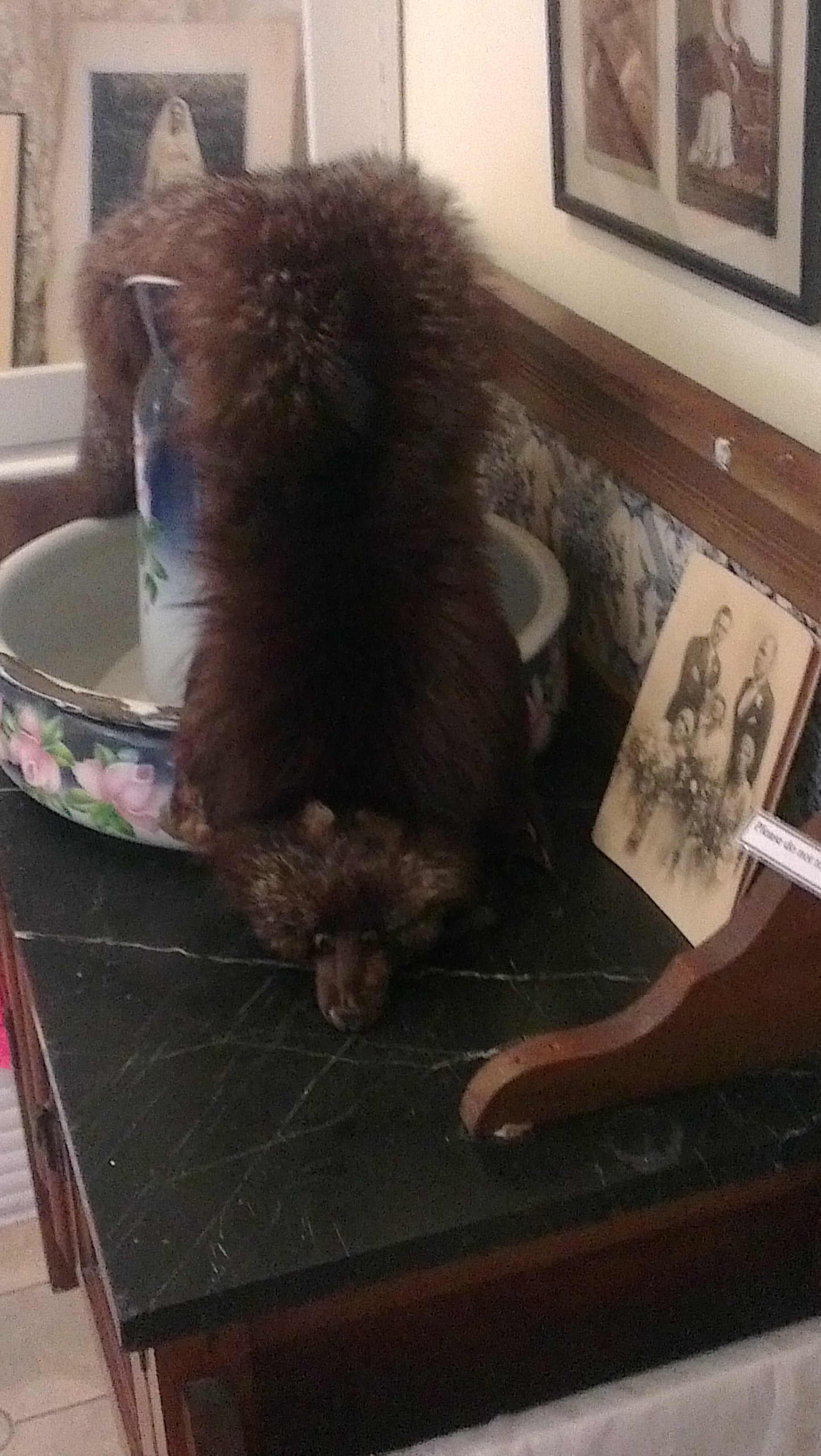
A little further along is a room with church history from the area, unfortunately currently being restored after a water leak, but including one of the original pretty stained glass windows from the Presby church. There is also a small room of bridal-wear and women’s clothes. Some pretty dresses, some really not attractive at all – apparently bad taste is timeless. Also several dead things that women would have worn around their shoulders.

Next, a room on butter making. Yes, totally quirky but quite fun. Also a little bit about the wars. Including a bit about the Anglo-Boer War (South African War) action that took place in this part of the world. Somehow, I always picture the South African War being primarily a Transvaal/Free State affair. I was surprised to discover, a few years back, that the small town of Stutterheim near East London in the Eastern Cape was involved. Even that didn’t have actual fighting. Apparently there is a moment outside of town to the Afrikaner leader who perished after the British took back Darling after he’d captured it.

Alongside the main part of the museum is a barn full, we were told, of agricultural implements. Actually, what it is mostly full of is transportation history – horse-carts and ox-wagons, what must be an ancestor of a combine harvester and even the tanks and stands from an old shell garage. It’s quite an impressive collection for a small town museum.

After the museum, we drove around town. This did not take long. Darling has some lovely houses and some pretty churches, a wine estate on the edge of town, a few shops, a hotel and that is about all. Some of the roads are tarred. There is also a “mall”, by which they mean an old converted house that now houses a bookshop, a cafe and a few other small shops. Sadly it appeared closed on a Saturday afternoon.

After Darling, we took a quick swing through Ysterfontein to see the sea before heading back to Somerset West. Also, a very strange farm stall inviting visitors to stop and see their black panthers, tigers and brown and white lions.

Dusty settler towns like Darling always make me wonder if I’ll find myself, one day, in a similar dusty, small town in another part of Africa and if it’ll feel anything like Darling.